

This essay was originally written for the Freedom and Sovereignty Initiative Europe (FSI Europe) Substack. FSI Europe is an initiative I have recently set up along with former colleagues from MCC Brussels to make the case for a Europe of sovereign, secure and dynamic nation states — and to support the patriotic movement with the ideas, arguments and reach it needs to win. Subscribe to their Substack, follow them on X, and donate to support the movement.
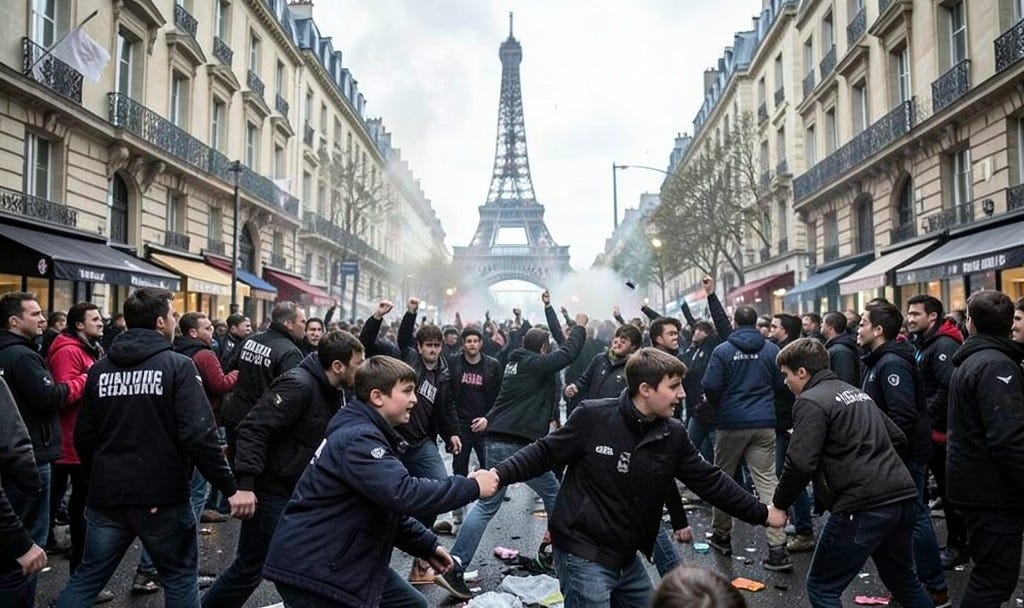
French society is slowly waking up to the fact that long standing moral norms that endowed people’s lives with a sense of security have lost their authority amongst a significant section of society.
As a sociologist I totally understand that riots can have legitimate causes. Currently it is the poor state of French schools and an education system that appears to have lost its way that has sparked off the urban disturbances engulfing France. I also understand that it is often difficult to make an airtight distinction between a protest and a riot. A protest can easily get out of hand and trigger acts of violence. I can also grasp that when a large number of children and teenagers are in the forefront of a protest movement its containment becomes tricky and in such instances the police may want to carefully consider the tactics it deploys. However, whatever its original causes, at some point a riot needs to be called by its right name, which is that it is a riot.
It should be evident that the disturbances in France today, do not simply involve protesting students but also organised and semi-organised activists who are motivated by the goal of violently disrupting everyday life. Even more importantly these activists are driven by a hatred of the norms and values that underpin French society. Their action suggests that they are not only estranged from the nation that they inhabit but also driven towards supporting the moral or cultural replacement of what it means to be French.
The protestors and even the rioters who have occupied the streets of France in the past, such as the Yellow Vest movement, knew that there were certain limits to any manifestation of anti-social behaviour. Even the student protesters of 1968 understood that it was wrong to burn fire-engines or stand by and watch while a fire-fighter was engulfed in flames.
Today’s rioters casually breach the moral restraints associated with civilised norms. Take the example of a headteacher of a sixth-form college who was doused in petro and beaten by rioters.[i] Check out the video that shows a group of masked rioters dressed all in black attacking a fire engine outside Lycée Saint-Exupéry in Marseille. A crowd can be seen hitting the emergency vehicle with blunt objects and smashing its windows[ii]. When a bright flame envelops the driver’s cab, a cheer from the crowd can be heard.
Dozens of teachers attempting to protect their schools from violent damage have been hurt. One piece of footage shows a young person, sporting a hood, running up to a teacher attempting to put out a tree fire and dousing him with petrol. Seventy-eight school staff were wounded during the course of last week’s riots. Such violent attacks on teachers are totally unprecedented in France. Twenty-four schools have been burned or ransacked according to official sources[iii]. Consequently, lessons will be suspended in up to 500 secondary schools during the week of 5 October.
Probably one of the most shocking scenes caught on camera shows a hooded person using an aerosol can and a lighter to launch a burst of flame at a woman calling for an end to the violence. After using his makeshift flamethrower to damage the woman’s face he calmy walked away. Later it was reported that the victim of this attack suffered from first degree burns to her face.
The most disturbing feature of the riots is not so much the scale of violence engulfing France, but the mood of hatred directed by the rioters towards French society. The most active adult supporters of the riots have been the Islamo-leftist party, La France Insoumise (LFI). Some of the members of the French Assembly of this party were spotted during the course of the riots wearing the traditional French tricolour sash. This sash is usually worn during the course pf performing official duties. However, in this case it was a performative gesture designed to lend legitimacy to the disturbances.
In reality, the tricolour was conspicuous by its absence during the course of the riots. On the contrary, the students and their adult allies were much more likely to wave the Palestinian flag than the tricolour. One video shows young students vandalising a school draped in Moroccan flags[iv]. The preference of the protesters for flags foreign to France highlighted their cultural detachment from French society. Their behaviour and slogans represent the antithesis of a sense of nation and patriotism.
The LFI has played an important role in encouraging people’s alienation from the values of France. Some of its MPs used the occasion to teach France a lesson. For example, Ritchy Thibault, an activist and a former parliamentary aide for the LFI was arrested for urging a crowd to burn down the Élysée Palace. He stated that;
‘We’re going to attack every police station in this country,” he told a crowd in the Paris suburb of Saint-Denis. He warned, “Tomorrow, we’re going to set the Élysée Palace on fire’.”[v]
Other LFI activists were also busy stoking the flame of violence. ‘Violence can become legitimate at a certain point’ enthused Bally Bagayoko, the LFI mayor of Saint-Denis.
The LFI is frequently described as far left. Although it uses a language traditionally associated with leftist rhetoric, in recent years its focus has shifted from the politics of class to that of identity politics. It has opportunistically decided to cultivate the identity of immigrant communities and has enthusiastically embraced an Islamist worldview. Consequently, in recent times the LFI has come to serve as a vehicle for promoting behind the scenes what Florence Bergeaud-Blackler characterised as something that ‘looks very much like intifadas’[vi]. From this perspective the riots can be interpreted as ‘little intifada’ serving the cause of undermining French cultural forms; if you will an exercise in cultural replacement.
In the first instance the malaise afflicting France is cultural. The phenomenon of the little intifada is unlikely to be confined within the borders of this nation. Many European countries face a similar threat to their national identity. It is time that Europeans understood that what is at stake is a war directed at their culture.
It is worth noting that sections of the French centrist and leftish media were much more concerned with the reaction of the police to the rioters than to threat represented by mob violence. An editorial in Le Monde noted that the ‘authorities should have listened to students first’[vii]. It approvingly cited a so-called researcher, Olivier Fillieule, as stating that ‘accepting a degree of disorder when an immediate response could lead to greater harm must remain the principle behind maintaining public order’[viii]. Fillieule wrote that ‘with minors involved, the risk of causing serious injury should be the top concern in maintaining public order’. From this standpoint, protecting rioting minors from injury trumps the necessity of dealing with the displays of violence on the streets of France.
Not all students are prepared to go along with this narcissistic rage against the culture and values of the French nation. Some students groups, such as La Cocarde Étudiante, have launched actions aiming to “unblock” the universities which leftist protestors have attempted to shut down. Such actions, which in the current climate are especially courageous, represent an important reaction to the mainstream positions of apathy and nihilism. These actions should be applauded. Nonetheless, such actions clearly do not enjoy the widespread institutional support that the protestors enjoy within the left-progressive political milieu.
Tragically sections of the mainstream media have decided to frame the school riots as an issue of child protection rather than what it represented, a challenge to the integrity of the French nation. The point that escaped many commentators is that main battlefield of the riots were the institutions that are responsible for the socialisation of young people. The attacks on these institutions indicate that many of these schools have not succeeded in performing this task and are at a loss to know how to educate the young to become responsible French citizens. Certainly, the teachers’ unions who have decided to join pupils in a ‘day of action’ on Tuesday are not aware of their responsibility for familiarising young people with the values of France.
This essay was originally written for the Freedom and Sovereignty Initiative Europe (FSI Europe) Substack. FSI Europe is an initiative I have recently set up along with former colleagues from MCC Brussels to make the case for a Europe of sovereign, secure and dynamic nation states — and to support the patriotic movement with the ideas, arguments and reach it needs to win. Subscribe to their Substack, follow them on X, and donate to support the movement.
[i] https://en.ilsole24ore.com/art/student-protests-in-france-65-school-staff-injured-including-40-headteachers-damage-to-over-a-hundred-schools-AJQesPWB?refresh_ce=1
[ii] https://www.bbc.co.uk/news/live/cmx2z20vz124t
[iii] https://www.france24.com/en/france/20261004-up-to-500-french-schools-to-be-totally-or-partly-closed-monday-due-to-protests
[v] https://www.telegraph.co.uk/world-news/2026/10/02/hundreds-of-french-schools-close-amid-violent-protests/

Florence Bergeaud-Blackler

@FBBlackler
Et attention LFI n’est pas un parti comme les autres. Il est révolutionnaire, on le sait, mais surtout habité par des islamistes qui organisent quelque chose qui ressemble très fort à des intifada. Le but de ces islamistes c’est la déstabilisation en vue de prendre des morceaux…

Le Figaro @Le_Figaro
Blocus de lycées : LFI a joué un rôle clé selon le renseignement français → https://t.co/7SAexLpAhf
7:10 AM · Oct 3, 2026 · 35.8K Views
108 Replies · 1.88K Reposts · 3.96K Likes
[vii] https://www.lemonde.fr/en/opinion/article/2026/10/02/french-high-school-protests-authorities-should-have-listened-to-students-first_6758174_23.html
[viii] https://www.lemonde.fr/en/opinion/article/2026/10/03/high-school-protests-with-minors-involved-the-risk-of-causing-serious-injury-should-be-the-top-concern-in-maintaining-public-order_6758199_23.html
Excellent summation. This is another aspect of the collapse of authority, this time manifested in education. It seems that these children have received little in the way of actual education, only empty affirmations. The result has been to create a resentful mass, whose actions here will prove ultimately to be self destructive. Whilst the demand for better resources in education is perfectly legitimate, the glee with which these same resources are destroyed by students, and the unthinking indulgence shown toward this behaviour by the Left demonstrate that the conditions in the schools are not the real issue here. The attacks upon firefighters, teachers and members of the public show that the vacuum left by modern educational practices have allowed a profoundly reactionary and anti-civilizational form of identity politics to take root. Some have suggested this is a tragedy where there is right on both sides:, but what right lies in the empty gesture of waving the flag of a country that you do not live in, whilst destroying resources you ultimately depend upon in the country you do? In order for these kids to have a chance they have to loose, and the French state despite it's limitations has to win. The alternative is a nihilistic violent mess ruled by thugs and fundamentalists.
Videos of the riots show few girls and mostly young brown and black men.
For Melanchon , no doubt his Muslim brothers who will bring socialism to France and avenge the failure of 1968 where his French Christian brothers failed. (I paraphrase)